
The Essential Guide to ICL Surgery in Singapore (2026)
Discover how Implantable Collamer Lens (ICL) surgery offers freedom from spectacles and contact lenses — with greater flexibility and benefits than laser vision correction.

Like many people who wear spectacles and contact lenses to improve their eyesight, you would probably have longed for a solution that does away with the inconvenience and risks from using them. You would also have probably heard of LASIK and how as a surgical procedure, it is able to give you the desired freedom from using spectacles and contact lenses.
LASIK or more accurately Laser Vision Correction (LVC), corrects refractive errors such as myopia (short-sightedness), hyperopia (long-sightedness) and astigmatism. As its name suggests, it utilises a laser to correct the refractive errors. There are 3 main types of LVC: ReLEx SMILE, LASIK and Advanced Surface Ablation (PRK, Epi-LASIK, LASEK, TransPRK) – refer to the table in the next section for the differences.
As long as LVC has been around however (since the 1990s), there is another procedure which is able to give you the independence from spectacles and contact lenses but with greater flexibility and benefits. The Implantable Collamer Lens (also colloquially known as Implantable Contact Lens) (ICL) surgery, involves placing a permanent contact lens in your eye to correct myopia, hyperopia and astigmatism. It is considered an additive vision correction procedure, which works in harmony with your eye in a natural fashion. The procedure is a day surgery, takes only about 20 minutes for each eye and has the following key benefits:
Key Benefits of ICL Surgery
Minimally Invasive
Small incision of only 2 to 3mm, resulting in faster healing and minimal discomfort.
Preserves Cornea Integrity
Suitable for thin corneas — unlike LVC, ICL does not remove corneal tissue from the eye.
Superior Vision Quality
Provides a better quality of vision than LVC especially at higher levels of prescription.
Lower Dry Eye Incidence
Lower incidence of dry eye and seeing haloes and starbursts at night compared to LVC at high levels of refraction error.
Reversible Procedure
Should the need arise, the ICL can be removed without permanently altering the eye's natural structure.
Option for LASIK Rejects
People previously rejected for LVC due to higher degree of myopia or astigmatism, dry eye, thin or irregularly shaped corneas, can now look at having an ICL surgery done instead.
ICL Surgery Vs Laser Vision Correction
Key Aspects and Benefits Compared
| Aspects of the Procedure | ICL Surgery | Laser Vision Correction (LVC) | ||
|---|---|---|---|---|
| LASIK | ReLEx SMILE | Advanced Surface Ablation | ||
| Suitable for higher prescriptions of myopia, hyperopia & astigmatism | ✓ | ✕ | ✕ | ✕ |
| Maintaining corneal integrity – to retain clear and good vision | ✓ (does not remove corneal tissue) | ✕ (removes corneal tissue) | ||
| UV protection | ✓ | ✕ | ✕ | ✕ |
| Process is reversible | ✓ | ✕ (removes corneal tissue) | ||
| Possibility of future procedures | ✓ | Limited if it involves the cornea | ||
| Minimally invasive | ✓ (incision of only 2mm to 3mm) | ✓ (flap of only 22mm) | ✓ (incision of only 4mm) | ✓ (flapless) |
| Suitable for thin corneas | ✓ (does not involve thinning of corneas like in LVC) | Limited (cornea may be too thin for flap creation) | Limited (cornea may be too thin for lenticule removal) | ✓ (no flap needed) |
| Causes dry eye | ✕ * | ✓ (highest level of the 3 LVC) | Sometimes | Sometimes |
| Haloes & starbursts | Sometimes (lower incidence than LVC) | Sometimes | Sometimes | Sometimes (takes the longest time among the 3 LVC to diminish) |
| Resumption to work | 1 week | 3 days | 3 days | 1 week |
The Implantable Collamer Lens (ICL)
In ICL surgery, there is no need to remove the natural lens. The ICL is permanently positioned inside the eye between the iris and the natural lens.
ICLs are designed to last over a long period, usually until the time when cataract surgery is required. As indicated in the table in the previous section, the procedure is reversible, so if the need arises, for example, a major change in prescription or to keep pace with technology, the ICLs can be removed.
"The reversibility of ICL surgery is a unique advantage – should eye health conditions change, the lens can be removed without permanently altering the eye's natural structure."
At Atlas Eye, we use the EVO and EVO+ Visian ICLs that are developed by STAAR Surgical. The product first received the CE mark in 1997 which indicates that it is approved by the European Union and other countries including Singapore that recognise the mark.
The ICL is made of Collamer®, a proprietary material that contains collagen, a naturally occurring protein inside your body, which makes it compatible with your eyes. In addition to being soft, flexible, and comfortable when implanted, the ICL also provides UV protection.
"ICL surgery may be suitable for individuals who are not candidates for LASIK or other laser vision correction procedures, such as those with thin corneas or high prescriptions."
How ICL Surgery Works
Suitability for ICL Surgery
You may be suitable for ICL surgery if you meet the following conditions:
You May Be Suitable If:
- Aged 18 and above
- Have myopia (short-sightedness) in the range of -0.50 to -18.00
- Have hyperopia (long-sightedness) in the range of +0.50 to +10.00
- Have astigmatism in the range of -0.50 to -6.00
- Have an anterior chamber depth (space between iris and corneal endothelium) > 2.9 mm and angle > Grade III 1
- Have a stable prescription for the past 12 months
- Not pregnant or breastfeeding
You May Not Be Suitable If You Have:
- Ocular hypertension in either eye
- A previous or pre-existing ocular disease that would preclude post-operative visual acuity of 20/60 or better
- Cataract in the operative eye or non-traumatic cataract in the non-operative eye
- Glaucoma that is primary open angled or narrow angled (glaucoma is a condition where the optic nerve is damaged which may lead to blindness)
- Low/abnormal corneal endothelial cell density, Fuch's dystrophy or other corneal pathology
- Amblyopia (lazy eye) or are blind in the non-operative eye
To ascertain your suitability for ICL surgery, you would need to schedule an ICL evaluation with your eye surgeon to undergo a proper evaluation.
Pre-ICL Evaluation
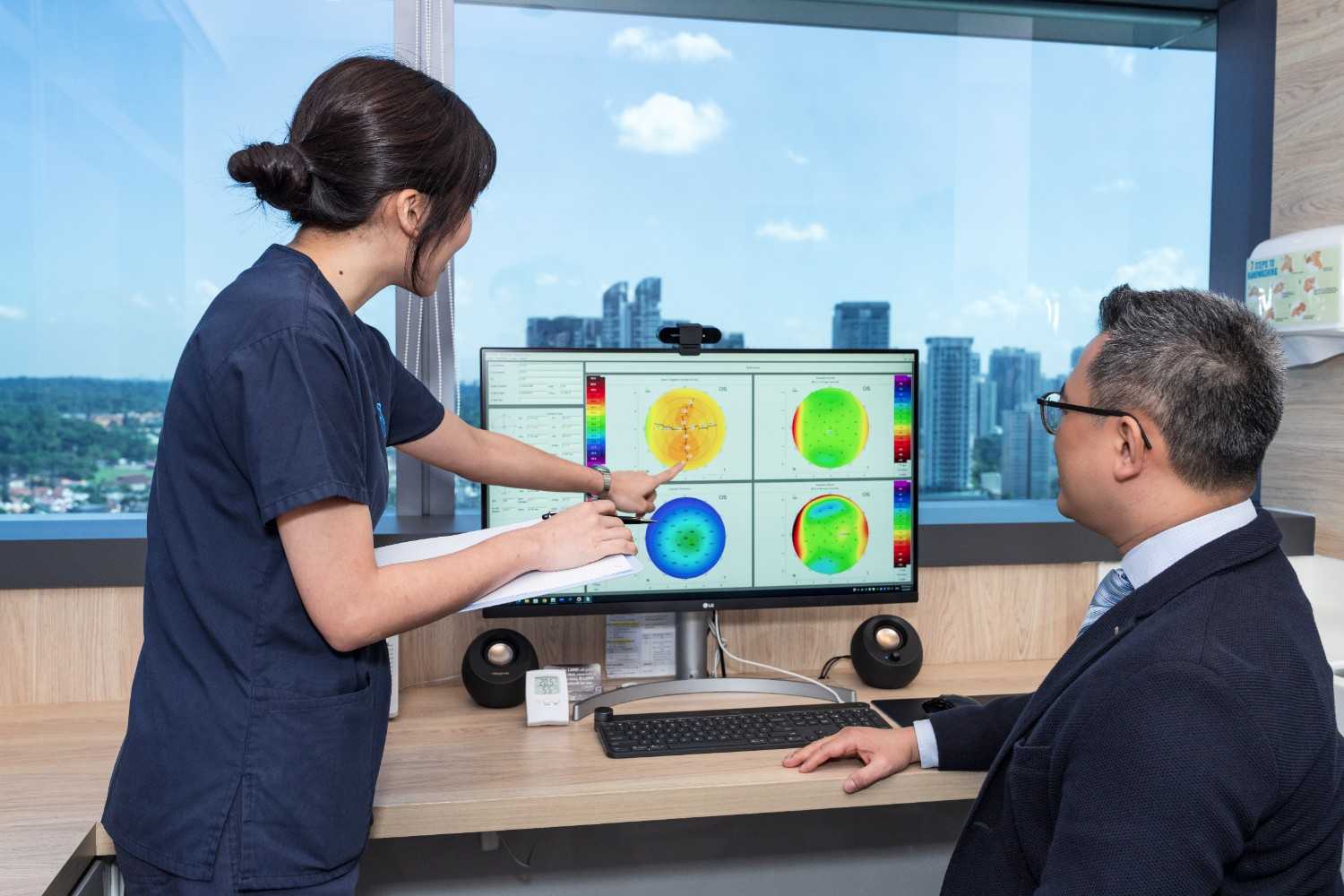
During the evaluation, your eyes will be checked for the level of refractive error (via manifest refraction), corneal thickness and shape, intraocular pressure (fluid pressure within the eye), etc.
You would need to stop using your contact lenses 3 days prior to evaluation if you are using soft contact lenses, and 14 days prior to evaluation if you are using hard contact lenses.
On evaluation day, eyedrops will be administered to dilate the pupils. A temporary effect of this is that you need to remove your glasses for near vision (far vision remains unaffected). Your eyes will also be more sensitive to bright lights so you might want to bring your sunglasses along as the effects of dilation will usually wear off after 4 to 6 hours.
What to Expect When Undergoing ICL Surgery
Before surgery, you would need to stop using your contact lenses in the same manner as before undergoing the evaluation; 3 days prior to surgery for soft contact lenses, and 14 days prior to surgery for hard contact lenses.
On surgery day, you should not drive, so take a taxi or get someone to drive you home. Be prepared to stay in the hospital for about 2 hours, even though the surgery for both eyes itself takes about 30 to 40 minutes.
Step 1: Preparation
The first thing that happens when you arrive is for the doctor to administer eyedrops to anaesthetise your eyes and to dilate your pupils – bring your sunglasses to wear after the surgery to minimise sensitivity to bright light.
Step 2: Incision
The surgery begins with a small incision of about 2 to 3mm being made at the base of your cornea. This is relatively painless due to the anaesthetic eyedrops applied earlier.
Step 3: Lens Insertion
Next, the surgeon folds the ICL and inserts it through the incision. Adjustments will then be made to ensure that it is positioned correctly.
Step 4: Repeat & Complete
The procedure is repeated for the other eye if required, after which the surgery is completed.
Step 5: Post-Surgery Care
You will be prescribed eyedrops to cleanse your eye and prevent infection from occurring. The incision will self-heal and your vision will start to improve over the next 48 hours. Follow your doctor's instructions including returning for follow-up visits.
Recovery post-ICL Surgery
Within a day of the surgery, you should recover about 75% of your vision. You should be fit to return to work the following week.
For the next month or so, you may experience some fluctuation in your vision. This is a normal part of the healing process so there is no need for concern. You can expect your vision to fully stabilise within 3 months.
After surgery, ensure you return for your follow-up visits during the following times: the next day, the week after, 1 month after, and 6 months after.
Guidelines to Ensure a Quick Recovery
In addition to strictly following all the medication instructions given by your eye surgeon, you are to observe the following to prevent any delay in your recovery:
- As with all procedures, you should not drive, operate heavy machinery, or drink alcohol during the first 24 hours.
- Avoid too much reading, computer work, and watching television during the first week after your surgery.
- While sleeping during the first week, use the eye shields that are provided to protect your eyes from being rubbed on accidentally. It is also advisable not to travel during this first week.
- Stay indoors if you can during the first week. If you are unable to do so, avoid going to dusty and smoky areas as particles may enter and irritate the eyes. Better yet, wear protective glasses if you have to leave the house.
- Likewise, during the first week, avoid water entering your eyes when you are having a bath or washing your hair. The same goes for applying makeup and cooking during this time as the chemicals in makeup and cooking fumes may irritate the eyes.
- During the first 1 month after the surgery, you should not swim, do hot yoga, or use the jacuzzi, sauna, and hot tub.
- Also, avoid contact sports and heavy lifting during this period.
- Use a headband when you are exercising to prevent sweat from entering your eyes.
Side Effects & Complications of ICL Surgery
As with any form of surgery, there may be side effects and complications arising from the procedure. However, ICL is considered to be a low-risk surgery, for example, the risk of infection is about 1 in 1,000 people.
When it comes to side effects, they are usually temporary. The more common ones are haloes and starbursts around lights, especially at night. When compared to laser vision correction, these side effects are mild and will usually go away after about 3 months.
Regarding complications arising from surgery, there is a small probability of the following occurring:
Potential Complications
Early onset of cataract – as the ICL is positioned next to the natural lens, the immediate contact may inadvertently precipitate cataracts to form earlier.
Secondary glaucoma – a condition arising from increased eye pressure which may result in optic nerve damage and vision loss. In the rare event of this occurring, your surgeon will prescribe eyedrops to lower the pressure in the eye. If the eyedrops are still ineffective, the ICL can be removed to prevent further complications.
With the standard of today's technology and equipment, the likelihood of early onset of cataract, secondary glaucoma and other types of complications, is generally low albeit they are still risk factors you must consider before proceeding with the surgery.
⚠️ Contact Your Surgeon Immediately If You Experience:
The above may be indicative of an infection, which are to be treated in a timely manner.
It is also advisable that you go for yearly reviews after the surgery to screen for cataract and glaucoma, and to check on your general eye health.
Cost of ICL Surgery
Here in Singapore, ICL surgery for both eyes ranges from $8,000 to $15,000. The difference in cost can be attributed to:
The experience of your surgeon – senior and experienced surgeons command higher fees. The type of hospital and the facilities chosen. The number and types of pre-surgery evaluation processes as well as post-surgery follow-ups and reviews.
For the cost of ICL surgery, please refer here.
Medisave & Insurance for ICL Surgery
As refractive errors (short-sightedness, long-sightedness and astigmatism) are not considered eye diseases, you are unable to use Medisave (applicable to Singaporeans and Permanent Residents) for the ICL surgery. As for insurance policies, they generally do not cover ICL surgery but ask your insurance company if there are provisions for it.
Choosing the Right Eye Centre / Eye Surgeon
To help you decide which eye centre and eye surgeon to choose for your surgery, you may want to look into the following:
Ultimately, the choice you make should be the one that meets all your requirements – do not compromise when it comes to your health and well-being.
References:
1. https://www.opticianonline.net/cet-archive/129
2. https://pubmed.ncbi.nlm.nih.gov/29394074/
Frequently Asked Questions
Soft contact lens users are advised to cease for 3 full days before the assessment. For Rigid gas permeable (RGP) lenses or hard lenses, patients are recommended to cease usage for 14 days before the assessment. For ortho-keratology lenses, patients must stop wearing lenses for 1 full month before the first assessment. The clinic would be able to better advise on the full duration that you need to cease lens wear.
The pre-surgery assessment typically takes about 1 to 2 hours, including all the necessary tests and consultation with the surgeon.
Eyedrops will be administered to dilate the pupils. A temporary effect is that you will need to remove your glasses for near vision (far vision remains unaffected). Your eyes will also be more sensitive to bright lights. The effects of dilation usually wear off after 4 to 6 hours.
No, you should not drive on surgery day. Please take a taxi or arrange for someone to drive you home.
Be prepared to stay in the hospital for about 2 hours, even though the surgery for both eyes itself takes about 30 to 40 minutes.
Yes, ICL surgery can typically be performed on both eyes on the same day.
Anaesthetic eyedrops are used to numb the eyes. No general anesthesia or injections are required.
You should be fit to return to work the following week after surgery.
Within a day of the surgery, you should recover about 75% of your vision. Your vision will start to improve over the next 48 hours and fully stabilise within 3 months.
During the first week, avoid excessive reading, computer work, TV, dusty areas, and getting water in your eyes. During the first month, avoid swimming, hot yoga, saunas, contact sports, and heavy lifting.
You should wait at least 1 month after surgery before swimming, using a jacuzzi, sauna, or hot tub. Light exercise can be resumed earlier with a headband to prevent sweat entering the eyes.
ICL surgery for both eyes ranges from $8,000 to $15,000 in Singapore. For the full cost breakdown, please refer to our fees page.
As refractive errors are not considered eye diseases, you are unable to use Medisave for ICL surgery.
Insurance policies generally do not cover ICL surgery, but you should ask your insurance company if there are provisions for it.
Yes, ICL surgery is suitable for people with thin corneas as it does not involve the thinning of corneas like in laser vision correction. Schedule an ICL evaluation to confirm your suitability.
ICL can correct myopia up to -18.00, hyperopia up to +10.00, and astigmatism up to -6.00.
ICL surgery does not involve the removal of corneal tissue and will not exacerbate your dry eye condition. If your dry eye is the result of wearing contact lenses, not having to wear them after ICL surgery may actually result in decreased dry eye symptoms.
Your eye surgeon will be best placed to advise on this. ICL offers advantages like reversibility, corneal preservation, and superior vision quality at higher prescriptions. LASIK offers a quicker return to work (3 days vs 1 week). Discuss your specific needs with your surgeon.
ICL surgery has a resumption to work time of about 1 week, while LASIK and ReLEx SMILE allow a return to work in about 3 days.
ICLs are designed to last over a long period, usually until the time when cataract surgery is required. They can be removed if the need arises.
Yes, the ICL can be removed if needed, for example due to a major change in prescription or to keep pace with technology. This is one of the unique advantages of ICL over laser vision correction.
Yes. Follow-up visits are scheduled for the next day, the week after, 1 month after, and 6 months after surgery. Yearly reviews are also advisable to screen for cataract and glaucoma.
The ICL can be removed during cataract surgery. The reversibility of ICL means it does not interfere with future cataract treatment.
Contact your surgeon immediately if you experience redness, swelling, sharp pain, tearing, or blurred vision. These may be indicative of an infection which should be treated in a timely manner.
ICL is considered a low-risk surgery. The risk of infection is about 1 in 1,000 people. The likelihood of complications such as early onset cataract or secondary glaucoma is generally low with today's technology.
Haloes and starbursts around lights may occur, especially at night, but ICL has a lower incidence of these compared to laser vision correction. They are typically mild and usually go away after about 3 months.
No. The ICL is made of Collamer®, a soft, flexible, and biocompatible material containing collagen. Once implanted, it is not felt in the eye.
You should avoid rubbing your eyes, especially during the first week. Eye shields are provided to protect your eyes while sleeping.
You should avoid applying makeup during the first week after surgery, as the chemicals may irritate your healing eyes.
No. The ICL is not affected by airport security scanners or any metal detectors.
It is advisable to avoid travelling during the first week after surgery. After that, air travel should be fine.
Your assessment results are typically valid for a limited period. Consult your eye surgeon to determine the appropriate timeframe between assessment and surgery.
Surgery can typically be scheduled shortly after a successful assessment, depending on the availability of custom ICLs and your surgeon's schedule. Your clinic will advise on the timeline.
If there is a significant change in prescription between your assessment and surgery, your surgeon will reassess and may need to order a different ICL. This is why a stable prescription for the past 12 months is a requirement for suitability.

DR DAVID CHAN
Senior Consultant Eye Surgeon & Medical Director
MB ChB (UK), M Med, FAMS, MRCS (Edin), FRCS (Edin)
Dr David Chan is the Medical Director and Senior Consultant Eye Surgeon at Atlas Eye Specialist Centre. As the ophthalmologist (eye doctor), he specialises in complex cataract surgery, anterior segment surgery and refractive surgery. His treatments include high-risk cataract surgery, lens replacement or exchange, lens capsular bag support, iris repair, laser vision correction (ReLEx SMILE/LASIK), collagen cross-linking, implantable contact lens and refractive lens exchange.